Showing posts with label Special Locations. Show all posts

Friday, March 2, 2018

Shearingvale - Roaringbridge House

Built in NR677 (30 years ago), the Roaringbridge House is a rough and rugged inn and waystop a stone's throw from the bridge that gives the inn its name. Food and drink are plentiful if not especially good, the rooms are comfortable enough, and the rates are cheap.
Roaringbridge House (Hexographer, 1 mile scale)

Innkeeper Garrick the Loud loves a good joke and a good fight, but if you break anything you pay for it, and then you sleep in the barn. The Roaringbridge House caters to adventurers, and also has what amounts to a general store for adventuring gear (rations, torches, lanterns, oil, rope etc...).
Roaringbridge House

Adventurers passing through are invited to sign Garrick's "Book of Names", a massive hidebound tome containing a great many names. One wooden wall of the common room is known as the Wall of Heroes, and contains the names of those in the Book who are known to have died or been killed. There are also a great many names carved on the Wall.

The Roaring Bridge - This forty foot long bridge spans a rocky chasm over the Perla Stream, a few miles above where it join the upper River Greve (~7 miles east of Grainger). The bridge gets its name from the constant roar of the water cascading over a series of small and medium sized waterfalls 20-30 feet below. The bridge itself is a wide wooden structure built on the stone piers of a much older bridge. There is an ancient elm tree that towers over the eastern end of the bridge. Adventurers often leave offerings to Asturia (goddess of luck, prosperity and good fortune) at this famous old tree.

Thursday, March 1, 2018

Shearingvale - The Lonely Cavalier

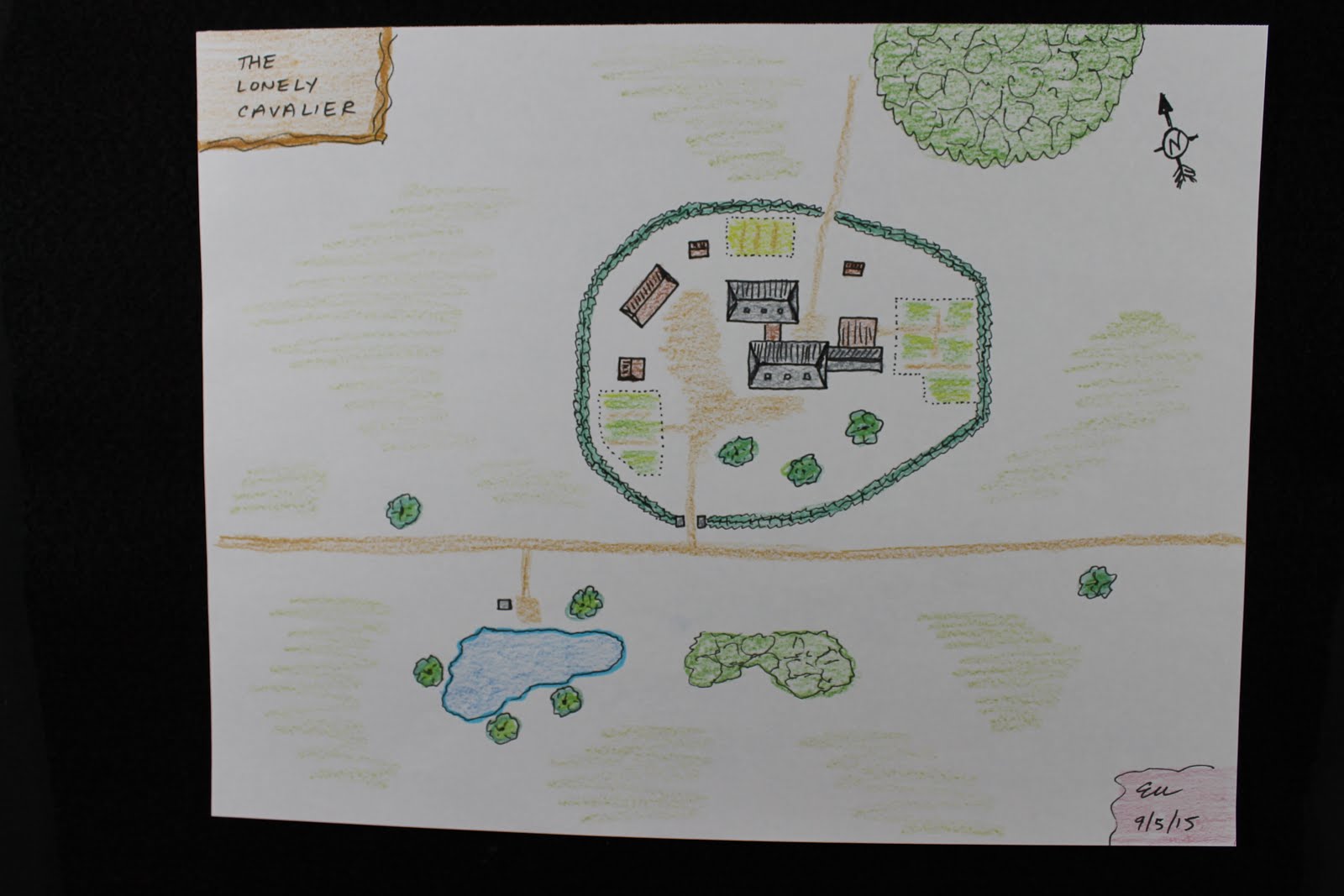
The Lonely Cavalier is a sprawling slate-roofed stone inn on the Road exactly halfway between Linden (11 miles west) and Grainger (11 miles east), a mile east of the point where the Tardesk trail branches off to the north. The Innilla family runs the inn, and is well known for their musical abilities. Braden Innilla, a bard of some note, along with his beautiful wife and three equally lovely young daughters, routinely serenade the guests with songs and instrument playing. Good behavior is expected; it is not a loud or raucous place.
The Lonely Cavalier (Hexographer, 1 mile scale)

The Cavalier is widely known to be shielded by a powerful Guardian Mageward, the boundaries of which appear as a very faint swirling mist running through the surrounding hedges. The Mageward gives off a faint shimmering green light at night.
The Lonely Cavalier Inn

The inn was built in NR694 (13 years ago) when Innilla was traveling through the area and recognized the powerful Mageward that encircled an old stone ruin for what it was. He quickly paid claim for the site and built the inn, settling down into a comfortable living with his family.
A typical roadside shrine

The Cavalier is moderate to high priced, but has good accommodations and excellent food. It is also very safe because of the Mageward. Across the Road, near a beautiful willow-lined pond, is a shrine to Metris (god of trade, commerce and travelers). The shrine has a locked donation box tended by Randor, a cleric of Meera from Linden.

Friday, February 9, 2018

Hills of Horeb

The Hills of Horeb, located between the Kalber Marshes and the Silver Hills, are a region of blighted hills, covered by warped and desolate woods. It is an unhealthy expanse of ash wastes, blasted remains of forests, petrified trees, and other unnatural wilderness. Something powerful and lasting happened here during the Elder Wars, and the land has never recovered. Patches of normal forest are growing back around the edges of the Hills, but the Hills themselves remain barren.

The headwaters of the mighty Swiftflow River, one of the great rivers of the Tempest Coast, are found in the southern Hills. The river flows southwest into the Kalber Marshes, which encroach on the Hills from that direction.

The Elder realm of Ithilkar owned this land in the olden days, and it was part of the Ilthilkar heartland, including the capital city of Prasinia and the influential wizard's town of Mirron.

Today, the Hills are a dangerous place, said to be populated with all manner of foul creatures, and haunted by the restless spirits of the dead of Ithilkar who fell in the final battles defending that land.
Hills of Horeb (Hexographer, 6 mile scale)

Prasinia
Located in the northwestern part of the Hills, the capital of the Elder realm of Ithilkar was one of the great cities of the North and a place of great beauty, known for its many pools and fountains. Today, little remains of the city other than large expanses of crumbled stone buildings, monuments and other landmarks. Despite the danger, the ruins of Prasinia attract many adventurers in search of treasure, and many of these never return. In addition to the many monstrous creatures who have taken up residence in the ruins in recent years, there are many traps and guardians that have survived from the Elder days. Survivors returning from the place say that something powerful and evil seems to hold sway over the ruins, and that lycanthropes are common.

Mirron
The Alberneth were an influential family in the Elder Days, essentially ruling the town of Mirron (in the realm of Ithilkar) in the southeastern Hills of Horeb. There were many powerful spell casters in the extended family, and they were the patrons of a famous (and somewhat notorious) wizards' school specializing in conjuration magic, the Tower of the Shadowed Veil. As the Elder Wars raged, there were concerns within the ruling circles of Ithilkar regarding the increasing use of dark magic by the Alberneth and their students, especially necromantic magic and the summoning of powerful fiends.

As the Wars raged on and things turned against Ithilkar, most of the population of the town of Mirron, including virtually all of the staff and students of the Tower, simply vanished overnight one night. Investigation by the authorities revealed that this was a planned evacuation, and that the missing people seemed to have gone down into the Underdark via old caverns and tunnels under the town.

Little was heard directly of the Alberneth thereafter, but occasional tales and rumors said that they had carved out a realm for themselves deep in the Underdark, where they devoted themselves completely to the pursuit of dark magic and demon worship. These tales said that even the drow avoided the territory claimed by the Alberneth.

Friday, October 27, 2017

Campaign Journal 44 - The Forbidden Hills

We last left our heroes aboard the Florian sky ship Golden Sunrise, heading toward the Forbidden Hills, and having sighted three wyverns approaching the ship from the front...

Monday August 26, cont. - Three wyverns (small ones it would turn out) approached the ship from high off the starboard bow. A tough fight ensued, including firing the ship's elemental-powered air cannon.

As the fight with the 3 young wyverns progressed, 3 more adult wyverns appeared from low off the stern (2 being ridden by hobgoblins). A few more crew members were killed, and the remainder of the crew took a good bit of damage in fending off the others.
3 young wyvern

At one point, Arian the sorcerer cast Fly on Thalmyr the dwarven paladin, and he flew over the side and down below the ship. A number of wyvern attacks put Thalmyr in a spot where one failed saving throw would send him plummeting hundreds of feet to a sure death, but he made the save and survived. Enough damage was done to the wyverns that the three wounded survivors fled off to the southeast.
...and 3 more adults

Continuing north into the Forbidden Hills, the ship flew over a ruined town on the north shore of a lake. Sharp eyes detected landmarks that they recognized, and the party was able to figure out that the  ruins below them were the ruins they knew as Nirinas, the town on the other side of the gate in the ruins of Ranatayza, near Fulcher's Hold and close to home.
Nirinas and the Forbidden Hills
(1 mile hexes in Hexographer)

The passed over the ruins without stopping, and spent an uneventful night camped a few miles north of the ruins.

In the morning, they continued the last few miles north to the Gods' Theater, which was easy enough to find, being a giant-sized amphitheater carved into the side of a large hill adjacent to the old road. The explored the site for a while, and then searched for the ravine through the hills that would take them to the cave and the gatestone.
The Gods' Theater

With the directions from the map, the ravine was easy enough to find, and they sailed the sky ship up the ravine to a secluded valley between the surrounding hills. There was a pond fed by several streams in the center of the valley, and had some scattered ruins on the eastern side. There was a very large cave mouth at the top of an old road leading up from the ruins.
Lara's Cave

As Octavian brought the ship in to land on a flat spot south of the pond, sharp eyes spotted a number of small humanoid creatures darting out of the ruins and into the nearby trees...

Next - Into the Cave...

GM Commentary - Another fun session with a blend of a tough fight (where Thalmyr almost died), some exploring, and some exposition about lore and history of the world. As far as maps, I still use Hexographer for the main maps of the world (at a one hex equals six miles scale), but have pretty much stopped using the software for the detail scale (like the 1 hex equals 1 mile scale shown above - from a detail map done long ago). I am finding it much more enjoyable to sketch out the smaller scale maps by hand.

Interacting with the World (what the characters learned...or were reminded of) - They visited a landmark that might tie into something down the road. More importantly, they learned that the "place beyond the gate" that they have been to several times is actually the ruins of the Onorian temple town of Nirinas, and they know where the location actually is on a map. They also know that the "home" end of the Ranatayza gate is only about a day's travel from Fulcher's Hold, and that the Nirinas side of the gate is only about a day's travel south of this new hoped-for gate location to a tropical land. These could be very useful in getting around...

Present - (again, too long ago, and I don't know...)

Wednesday, July 19, 2017

Ruins of Granrath

The ruins of the old Onorian city of Granrath lie at the western end of Lake Beranarr, at the point where a small river coming down out of the Telzek Hills enters the Lake. Granrath was the seat of one of the eight Dukedoms of the Elder realm of Onoria. The traitor Dukes of Granrath were responsible for the First and Second Granrath Wars in the 230's and 240's (~470 years ago). These wars were the result of Granrath rebelling against the Onorian King and provoking two civil wars. Eventually, Granrath was ceded to Ithilkar, its ally in the rebellion (in 251), but was destroyed soon after during the goblin and orc invasions of the Rivenrock Wars (circa 270).
Granrath and environs (in Hexographer)

The ruins lie a mere 25 miles east of the modern Castle of the New Dawn. Despite the clerics of the Castle desiring to clear the wilderness and make the region safe for settlers, they are conscientious, and are wary of sending all but the most experienced adventurers to Granrath, which is said to be haunted by the spirits of all the traitorous soldiers that took up arms against their king. Because of their history, the entire city and surrounding lands are said to be cursed.

Some legends say that the ruins of Granrath are still presided over by the spirit of Szorlag III, the last Duke of Granrath. Szorlag is rumored to be a powerful ghost, lich or worse.

Getting to Granrath from New Dawn is easy: go north to the river and follow it downstream until you reach the Lake. The ruins are where the river meets the Lake.

The ruins of the city spread along the coast of the Lake, and include the ruins of the citadel on the high ground northeast of the river. As would be expected of 400+ year old ruins, little remains above ground but the lines of stone walls, flagstone paved roads and plazas, sunken cellars, and the crumbled remnants of the larger monuments and landmarks.
Ruins of Granrath

Adventurers have recently reported young green dragons flying south from the Ravenwood and hunting in the ruins (in pairs or trios).

Sunday, July 16, 2017

New Dawn

[see June 2016 for a full post on this location]

Located about 40 miles northeast of the town of Forlorn, the Castle of the New Dawn and its related village are a small frontier outpost.
Castle of the New Dawn

The priesthood of Ardran and the Order of the Stalwart Shield seek to provide a safe haven for exploration and settlement of this little corner of the wilderness.

[I've gotten better at hand drawn cartography, but when I feel like scribbling out a quick map of a town in the world, I fall back on this style. It's crude but effective, and matches all the little town and village maps I've already drawn...]

Saturday, July 8, 2017

Campaign Journal 41 - Tower of Rethorcar

We last left our heroes having just entered the Tower of Rethorcar, in the ruined Onorian town of Zinasa...

August 16, Friday (cont.) - Standing in the entry foyer of the Tower, Badric the Cleric moved toward the center of the 30 foot diameter room in order to get a better view up through the hole in the ceiling. As he stepped into the red circle at the center of the carpet covering the floor, he began to levitate toward the hole in the ceiling. As he was rising up, Niam the Rogue was studying a portrait on the wall. The portrait was labeled "Damien Rethorcar", and looked just like an older version of Duncan the Wizard.

Wracking his memory for his knowledge of heraldry, Badric was able to recall (remarkably!) that the Rethorcars were a noble family known for their powerful wizards. When Onoria fell, the surviving members of the Rethorcars were believed to have fled southeast into what is now Mercia. The heraldic badge of Duncan's family is a red hawk, and one of the key elements of Rethorcar heraldry was also a red hawk. Duncan's family has lived in northern Mercia for generations...
The ruins of Zinasa

The trick to managing the levitation up (and down) from level to level was soon figured out by Niam, and the party set about exploring the Tower. Niam floated up through each floor, getting the general lay of the land. When approaching the sixth floor, it became apparent (too late) that the last floor was an illusionary trap, and he took a significant amount of lightning damage.

The fourth floor had one door, which Niam took electrical damage from when attempting to pick the lock.

The fifth floor had an ornate dragon door, with carved high relief heads of gold, silver and copper, each with a keyhole beneath it. So they had a door...but no keys. Yet.

For a tower of approximately 30 foot diameter when viewed from the outside, and also approximately 30 foot in diameter at the center of each level, most parts of the interior didn't match the exterior appearances. Each level had a number of doors and windows that made the interior of the tower far larger and more irregular than the outside. The other thing that the characters soon noticed was that the view out of all of the windows seemed to be random in both the view to be seen (scene, season, weather and time of day), and the apparent height above the ground.
Tower of Rethorcar

The party was looking for three keys of gold, silver and copper, and had six apparent tower floors to explore. One of the first things they noticed was that the temperature was a refreshingly cool ~70 degrees, compared to the 90+ heat outside. Also, for a tower that had supposedly been sealed inside an Invulnerable Mageward for the last ~350 years, the air was fresh and everything was clean, undisturbed and well preserved. Remarkably so.

The first floor had three hallways. One led to a series of doors that blinked characters from one door to another, seemingly at random. After some exploration, Malachy the barbarian went through one door and didn't reemerge from another. He appeared in different series of rooms, including what seemed to be a practice range for archery, knife and axe throwing, and a fitness training room containing all sorts of climbing, balancing and agility training obstacles. Flitting about this room was a copper key...but more on that later.

While Malachy was off on his own, the other members of the group explored a sitting room leading to a trophy room. The trophy room had heads of 9 different dragons and other reptilian creatures. The heads moved slightly and seemed to be watching the characters. While Badric was getting beat up by the flicking tongue of a giant frog, Niam managed to approach a silver dragon's head and remove a silver key from its mouth. A large red dragon head regarded them intently, but nothing else happened. A book on dragons was recovered from the sitting room.

The final hallway of the first floor led to an extravagant series of chambers. The first was a large and extensively decorated dance hall, complete with a magical music generating device. To the side of this room were a pair of dressing rooms flanking a room with three pools set into the floor - one with cool water, one with warn water and one with hot water. Steam filled the air.

After much chasing, falling and chasing again, Malachy (very bruised and battered) was able to obtain the elusive copper key. Continuing on, he explored a series of workshops, after which he found himself on the third floor landing. Malachy went down and found his way back to the party at this point.

Beyond the dance wall was a huge and well kept indoor garden. Looking down from a balcony near the entrance, the party could see a pair of pools flanking the room, and a large foundation near the far end. Gravel paths led through lush undergrowth. Niam identified some plants useful in brewing certain poisons. The fountain had a large carved stone dragon in the center of it.

The group explored the second floor next, and it proved to be a series of bedroom suites, containing a total of 5 nicely furnished bedrooms split between three suites (each with its own sitting room). Each bedroom had a magical fireplace whose level of flame could be adjusted or turned completely off. There was also a dining room, with places set for 14. Upon entering the room, a construct figure, looking like a clay figure sculpted by a child, entered the room from a far door, and asked a question in a language that they could not understand. Duncan the Wizard cast Comprehend Languages and was able to understand the figure, which asked again "what can I do for you?" Duncan replied "dinner for 5", upon which the figure went back through the far door (into the kitchens). It and another similar figure began making a wonderfully smelling dinner. Fifteen minutes later, dinner was served. It consisted of swordfish steaks, grilled vegetables and fresh baked bread. It was the best meal they had eaten since they left Linden (and better than most of those town meals...). A peek into the kitchen showed ovens, grills, prep stations, and a pair of doors extending beyond. The group did not enter the kitchen.

The third level had the workshops previously seen by Malachy. The main workshop had stone carving and alchemy areas. There were piles of stone chips around the stone carving area. To one side was a storage room. To the other was a wood carving workshop, with a plethora of tools, raw materials, and some partly finished furniture.

The group made another attempt at opening the electrified door on the fourth floor, but were stymied. It would take magic to open the door.

Revisiting some of the areas they had been through, Duncan noticed something odd about the green and yellow tapestries on the second floor. On closer inspection, the intricate embroidery proved to be the recipes for four lower level spells, once of which was Knock, a magical opening spell. Duncan didn't know the spell, but given enough time to study the tapestry, could learn it well enough to cast it once. Given more time and the right materials, he could copy it into his spell book.

Going back to the kitchen helpers, Duncan asked about the keys. After some back and forth, Duncan was able to glean the information "golden dragon in the water". Returning to the dragon fountain in the garden area, Badric was able to find a hidden compartment in the carved stone dragon's head containing a gold key...

Melior the Druid, returning later to the gardens, was stalked by a fey creature, and resisted being charmed by what turned out to be a dryad. The dryad, pouting, faded back into a nearby tree, and wasn't seen again.

The party then decided to rest for the night in the baths room, while Duncan studied the tapestry with the Knock spell, in the hopes of casting in on the fourth floor door on the morrow...

August 17, Saturday - With the knowledge of the Knock spell freshly in his mind, Duncan returned to the trapped electrified door on the fourth level, and was able to use the spell to open the door. Beyond was a sitting room, very nicely furnished. This led to an equally nicely furnished bedroom (obviously the master's), which had a large closet full of nice wizard clothes, a balcony, and a storage room. The storage room had a pair of chests. One was a simple chest containing ~1,000 GP in gems and ~1,500 in various old Onorian-era coins. The other was a smaller metal chest with an incredibly complex puzzle lock. Surprisingly (to the DM at least), Duncan and Niam working together managed to open the puzzle chest on the first try (an extended series of skill checks). Inside was a golden key. Their second golden key....

Next...Finishing the Tower of Rethorcar.

GM Commentary - Hopefully this session was amenable to my players. Not a single die was rolled in combat, although many were rolled for other purposes. I'm of the opinion that mixing up combat and non-combat content is important. Occasionally this results in an entire session leaning heavily one way or another without a good mix within the session. D&D as written doesn't necessarily agree, since if you aren't killing things, you aren't getting XP, and therefore aren't advancing your character and making them better in game terms. As always, I award XP for non-combat things, and while this was not a high XP session, it was certainly not a total write off.

Also...See my prior post on the doldrums. I have been stuck in the doldrums regarding this campaign for a little while now...but that is over. I'm excited again, and can't wait to figure out what comes after the Tower of Rethorcar. Lots of ideas are swirling. This is a good thing.

Interacting with the World (what the characters learned...or were reminded of) - Duncan may have a connection to Damien Rethorcar and the Rethorcar family, a family of well-known Onorian wizards.

Present: Melior (level 7), and Duncan, Malachy, Badric and Niam (all level 6).

Thursday, June 16, 2016

Laristen's Folly

About 100 years ago, in the early days of resettling the Northlands, a great cleric of Metris (in his aspect of protector of travelers) began building a stronghold in the far southwestern Iron Spire Mountains, overlooking the valley of the River Greve far below.
Laristen's Folly (in Hexographer)

Laristen's aim was to provide a safe haven for others exploring and settling the region. The nearest settlement was the then-tiny village of Wegley.

With the castle only partly complete, an orc horde accompanied by several giants swept down out of the mountains and massacred everyone, with the exception of Laristen himself, and cast down most of what had been built. Laristen, broken in spirit, is said to have disappeared into the far south, never to be heard from again.

Legend has it that his treasure, hidden in, around, or below the castle site, was never recovered. The ruins can easily be found in the foothills northeast of Wegley. The castle ruins are now known as Laristen's Folly...

Tychon's Tower

Located on a craggy hill at the north end of the Trollclaws, just a few miles south of the Road, is the multi-spired tower of the archmage Tychon. Tychon is a venerable half-elven evocation wizard who is rarely seen in public these days, although his retainers frequently visit nearby Nandra to buy food and other supplies.
Tychon's Tower (in Hexographer)

Tychon routinely accepted students (for a high price) in days gone by, but is less likely to welcome intrusions on his semi-retirement in recent years; many would-be students have been turned away.

It is said that his tower is protected by a Sanctuary Mageward (the most powerful kind of mageward in existence following the Weave-Rending). There are also a trio of metal statues flanking the entrance to his tower that are believed to be iron golems.

Wednesday, June 15, 2016

Torhaven and the Torvald Mines

The dwarven hold of Torhaven, and the Mines of Torvald that underlie the town, is the biggest producer of iron and steel in the North. Torhaven is located on the southern edge of the Iron Spire Mountains, 2-3 days' journey north of the city of Nandra. Torhaven consists of both an above ground town as well as a fortified underground dwarf hold.
Torhaven (in Hexographer)

Ruled by the Brighthammer clan, Torhaven is known to be connected to the Deep Realms, and has trade connections both above and below ground. The dwarves produce both raw metal ingots as well as finished metal goods and crafts of all types (and high quality).

Torhaven can also be a source of information, as dwarven sages and elders have extensive knowledge of dwarven history, lore, and knowledge of the surrounding lands.

Tuesday, June 14, 2016

Castle of the New Dawn

The settlement known as New Dawn, or more accurately the Castle of the New Dawn, is located in an area that is largely wilderness. It sits at the southern end of the Telzek Hills, west of Lake Beranarr (and therefore northwest of the Silver Hills). The nearest town of size is the town of Forlorn, 40-plus miles to the south/southwest.
Castle of the New Dawn (in Hexographer)

The Castle was founded in the year NR 659, almost 50 years ago, by a band of priests serving Ardran, the god of life, vitality and renewal. It was their goal to form a bastion in the Onorian wilderness around which civilization could re-form. Settlers would move in, farms would be established, towns and villages would grow, and the wilderness would be reclaimed for civilization.

The reality has not met the original goal, at least not so far. There are fertile farmlands in the gently rolling hills and excellent grazing lands all around, but the threats that still exist from being on the extreme edge of civilization pose a constant challenge, and the influx of settlers has been very slow.

New Dawn is a fortified hilltop town of approximately 250 souls. Perhaps another 250 people live in farms and homesteads close to the town. A series of stout stone watchtowers guard the area and provide early warning for monster attacks and other unwelcome incursions. The town walls and watch towers are manned by servants of the Temple of the New Dawn (the priests of Ardran and their retainers) as well as members of the Order of the Stalwart Shield [see below]). Retainers of the Temple of the New Dawn, known as the Dawnriders, patrol the lands and roads nearby mounted both on warhorses and flying hippogriffs.

The town trades with the high elves of the Forest of Kyrell (to the west) and the towns of the Great North Road to the south, bringing in necessities that cannot be produced locally.

Due to its location, the Castle also often serves as a base of operations for adventuring bands exploring the Onorian wilderness to the north and east, or the Onorian ruins that exist within a day or two's travel.

The Order of the Stalwart Shield - The Order is a group that is associated with New Dawn (and based there), but it is separate and distinct from the priesthood of Ardran. The Order is a group of warriors and others pledged to protect New Dawn, led by paladins of Brand (god of duty, honor and protection). Members of the Order serve as guards for the town, help man the watch towers, and patrol the surrounding lands.

Monday, May 2, 2016

Campaign Journal 26.5 - Interlude

The Silver Swords company and the Tombs of the Alberneth

The following is a recap of the many pages of scribbled notes, sketches, writings and maps related to the Tombs of the Alberneth.

Nath Ravenblood's Materials
An adventuring party of some note (the Silver Swords) found a well-hidden and difficult passage deep in the Underdark behind a series of waterfalls. The passage led several miles, coming out in a series of man-made (or creature-made) tombs. The party was able to use magic to read and transcribe inscriptions on some of the tombs and memorial carvings. They fought powerful undead and a number of fiends. The group lost two of its members (literally separated and lost, never to be seen again), but they were able to escape with sacks loaded with gems, jewelry, and strange gold and silver coins. [This occurred in NR 698, ~9 years ago]

Upon reaching home, the Silver Swords were able to research some of the names and carvings they had transcribed (with the aid of the sages of Talengard), and came to the conclusion that they had found the tombs of the Alberneth, a family of powerful spell casters who fled the surface world back in the time of the Elder Wars (~300 years earlier).

The Silver Swords intended to return to the tombs, but first went into the northern Tellarn Mountains (southeast of the Greenreach Woods) to investigate recent rumored sightings of the great (and near legendary) blue dragon Vassylspeere. Nobody is know to have returned from that expedition.

Years later, the Silver Swords' written materials found their way into the hands of Nath Ravenblood, a part-time adventurer and the last member of a fading minor noble family of Turil. Desperate for cash, Nath organized an expedition to recover treasure from the tombs. Shortly after entering the Deep Realms through the ruins of Kristovaria in the Greenreach Woods, Nath's party was ambushed by lizard-like humanoid creatures, and all but Nath were slain. Nath bargained for his life by promising to deliver additional slaves to the lizardmen. Later, the party intercepted Nath's hired slavers, tracked them back to Nath, and were given these materials...

The materials included detailed maps and notes on how to get from the ruins of Kristovaria to the secret entrance to the Tombs of the Alberneth.
The Elder town of Mirron (Hexographer, 6 mile scale)

Alberneth Background
The Alberneth were an influential family in the Elder Days, essentially ruling the town of Mirron (in the realm of Ithilkar) in the southeastern Hills of Horeb. There were many powerful spell casters in the extended family, and they were the patrons of a famous (and somewhat notorious) wizards' school specializing in conjuration magic, the Tower of the Shadowed Veil. As the Elder Wars raged, there were concerns within the ruling circles of Ithilkar regarding the increasing use of dark magic by the Alberneth and their students, especially necromantic magic and the summoning of powerful fiends.

As the Wars raged on and things turned against Ithilkar, most of the population of the town of Mirron, including virtually all of the staff and students of the Tower, simply vanished overnight one night. Investigation by the authorities revealed that this was a planned evacuation, and that the missing people seemed to have gone down into the Underdark via old caverns and tunnels under the town.

Little was heard directly of the Alberneth thereafter, but occasional tales and rumors said that they had carved out a realm for themselves deep in the Underdark, where they devoted themselves completely to the pursuit of dark magic and demon worship. These tales said that even the drow avoided the territory claimed by the Alberneth.

Monday, July 27, 2015

Campaign Journal 14 - Part 1, At The Dawnstone

We left our heroes on the evening of Saturday June 1, having arrived at the Dawnstone with the Granite dwarves Frayka and Meerak.

June 1 (cont) - Around the campfire that night, within sight of the Dawnstone, Frayka told the party the following story. He and Meerak (his kinsman) are from a group of Granite dwarves called the Farandui. The left their homeland in the distant south, beyond Rendalia, in early March. The name of the land translates to "Mountainhome", which the dwarves Thalmyr and Badric recognized as a near-mythical dwarven kingdom. They had traveled ~1200 miles in ~80 days, generally disguised, riding with caravans and merchant trains. As he told this part of the story, Frayka mumbled the words of a spell and transformed himself and Meerak to the appearance of regular dwarves. Frayka said that an artifact crucial to the safety and well being of their kingdom, and to the health of their Great Thane (who was in an un-wakeable slumber), had been lost. This artifact was called the Heartstone. Meerak was on a quest to craft a new Heartstone, and Frayka was his companion on the journey. Meerak believes that there are only a few places in the Realms where this item can be crafted, and that the Dawnstone is one of these few powerful primal places.

All through this storytelling, Meerak sat by himself on the edge of the firelight and read from a brass-bound leather tome. When he was done his reading, he asked to see some of the party's weapons, and spent some time inspecting, studying and mumbling over each of them in turn.

June 2 - After an uneventful night, the party was wakened by Frayka well before dawn. Meerak was dressed in elaborate black robes, which were covered with red and gold embroidered runes and symbols. He was laying out and organizing all sorts of materials on the Dawnstone itself: a large and ornate golden amulet with a hole in the center, a very large red ruby, a number of what appeared to be small rune-covered clay tablets, containers and jars of various powders and liquids, a large vial of a thick red substance, a small golden knife, and a small golden hammer encrusted with gems and inlaid with runes.

Frayka went to several characters and made requests to borrow Thalmyr's axe, Badric's warhammer, and Malachy's sword. He also asked that Thalmyr be ready to cast Protection From Evil and Melior be ready to cast Thunderwave. [It was at this point that one of the players observed "umm, is it just my imagination, or did we just let this guy disarm all of our melee guys?"]

When the first light of the morning hit the Dawnstone, it began to glow red deep within the translucent white stone, just as the legends said. Meerak began a complicated series of spells and rituals, sprinkling the liquids and powders on the clay rune tablets and then shattering them with the jeweled hammer. As the tablets were shattered, swirls of multi-colored magical energy were released, and were bound into the amulet. The dwarves in the group recognized that they were watching a Runesmith at work. [Aside:  Dwarven Rune Magic is a rare and powerful kind of magic that most people will never witness - Runesmith magic is the type of Rune Magic related to crafting metal items and weapons]. As the ritual continued, the Dawnstone glowed brightly, and tendrils of magical energy snaked out of some of the surrounding standing stones (which were now also glowing), coalescing around the altar, and creating a web of glowing and pulsing light and energy. As a final step, Meerak set the ruby in the center of the amulet, poured the thick red liquid over it (the blood of the Great Thane) and struck it with the jeweled golden hammer. There was a blinding flash of light, after which the ruby could be seen, embedded and glowing, in the center of the amulet.

As the light within the Dawnstone began to fade, Meerak, looking tired, performed quick rituals on each of the three borrowed weapons. While Meerak cast a spell over Thalmyr's axe, Thalmyr was asked to cast Protection From Evil. It seemed to those watching that Meerak's spell as able to capture the magical energy of Thalmyr's spell and cause it to vanish into the axe. Thunderwave cast on Badric's warhammer had a similar effect. Lastly, Meerak cast a final spell on Malachy's sword, then handed the small golden knife to Malachy and asked him to spill his own blood onto the sword. Mal slashed his palm, and drops of blood splattered onto the sword blade. The drops sizzled and smoked, and then were absorbed into the blade, leaving no trace. Meerak collapsed as the last light faded from the Dawnstone. The whole process took only 15 minutes.

The Heartstone ritual was a success.

After a short rest, Meerak handed Thalmyr's axe back to him, and said "this is a fine dwarven-forged weapon made 35 years ago by Tarrack Swifthand in the dwarven hold of Rockforge. It is a fine weapon that will serve you well." [In game terms it was now a +1 weapon that can invoke the Protection From Evil spell once per day].

Handing back Badric's warhammer, he said "this was made in Iron Gate 72 years ago by Brimdall Silvershard son of Sarndall, Use it well." [In game terms, the weapon can now invoke Thunderwave once per day, and is a "magic weapon", but not a '+' weapon. Brimdall Silvershard is of Badric's clan, and is in fact his great-uncle].

Meerak then told Malachy the following: "Your sword is Dralikin. It was forged in a place called Fellsar in the Elder days, by an elven craftsman named Friliar Stormwarden. It is a remarkable weapon, fit for a great warrior. It has lain dormant for a great many years. It is happy to have been awakened." When asked how he knew all this, he shrugged and responded "I asked it, and it told me."

When asked what enchantment had been placed upon it, Meerak hid the sword and then asked Malachy to concentrate on it, and tell him which stone it was behind. Malachy could sense the sword, and knew where it was. Meerak then asked him to concentrate again and call the sword to him. Mal did so, and the sword appeared in his hand. Meerak said "I have bound the sword to you, and you to it by blood. You can call it you and it will appear to serve you for as long as it wishes. I think it possible that it could choose not to respond to your summons, but I am not sure of that. Treat it well."

With that, Frayka presented the party with a few tokens of Granite dwarf friendship and the golden items they no longer needed (the hammer and knife), thanked them profusely, and teleported the two of them away. [Teleporting works fine for "going home", but is extremely dangerous when going to a place you don't know well. Teleporting to a place you hadn't been to at all, and weren't even sure where it was, would be suicidal.]

Next - North of the Dawnstone.

GM Commentary - The first two-thirds of this session (with the last third to come next), was good for revealing more of the mythology and background of the world, and provided the characters with some tangible benefits in terms of enchantments added to some of their primary melee weapons. There would be some exploring and fighting to come in the session. I like the mix of different aspects to a session. I especially like continuing to build the web of people that the characters have encountered, and what could be considered their circle of acquaintances and friends. This provides a lot of opportunity for going back to those relationships and drawing on those ties in the future.

Monday, May 18, 2015

Campaign Journal 11 - Visiting Talengard

We last left our heroes in Linden, preparing to journey to see the sages of Talengard, in the hopes of selling 65-70 antique books, and potentially gaining other information...

The party left Linden on Tuesday April 30, heading east on the Great North Road, in two horse-drawn carts. They had 65-70 antique books to sell, a 6 foot by 6 foot antique carved wooden artwork panel depicting a fight between several warriors and a dragon, as well as some pieces of salvaged arms and armor of modest value. These would all be sold to raise as much money as possible, and to gain information that would help the party's future explorations. Mordecai (NPC fighter) expressed an interest in cashing out his share of the treasure so that he continue a few days further on into Alsberg, where he could visit his father and give him some money.

The trip east through Wegley and Nandra was uneventful, and the party reached Talengard on Tuesday May 7th, 8 days out of Linden. Duncan and Niam (wizard and rogue) were dispatched to meet with the sages of Talengard regarding a potential sale of the books, while the remainder of the party stayed in the town of the same name.
Talengard and the Grand Duchy of Rimini (6 mile - Hexographer)

Duncan and Niam first met with a minor administrator, but when the size and rarity of the collection they were trying to sell became apparent, Oleran Graybeard, Master of the Library, came to discuss matters with them himself. Much of the day was spent in allowing time for numerous sages in various specialties to exam the works, after which some negotiating was needed. The sages valued the collection at 6,700 GP (a princely sum!), but as Bertram, the Master of Coin, explained, that was an amount of coin that they could easily come up with. The next day, it was agreed that 2,500 would be paid in cash, and 4,200 would be paid in "credit" for future services where the sages could be of use. The party was also provided with a much better map of Onoria than the very simple sketch map which was all they had access to previously, and a couple of small journals of adventurers who had traveled the area in the past.

Before leaving, Eustace of Jasla, the sage they had saved near Castle Langborne, and his mentor Bethziral (an elderly halfling) came to visit with the party. Knowing of their interest in Castle Langborne, Bethziral had some additional information to share. Based on her researches, she said that she believed Alferith Langborne was a direct descendent of the Tramantine family, and that was probably one of the reasons he returned to Brin-Dendra (as it was known in the Elder days). The Tramantine family were the Dukes of Sesteval, which roughly covered what is now the Shearingvale and surrounding lands in southeast Onoria. The other reason she believes he went to Brin-Dendra is because of the legends of something called the Soulfire Beacon. Legend has it that the Soulfire Beacon was the culmination of the Tramantine family's researched into dark magic. Some tales say that it is a powerful artifact that uses sacrificial life forces from the living to summon and control the dead. Others say that it is some sort of gate or portal to the underworld, or to a different plane of existence where the souls of the dead rest. Bethziral said that the only specific mention she had uncovered as to the location of the Soulfire Beacon is that it is near a place in deepest mines under the town, a place where the delvings had broken through into the Underdark. It is a place said to be holy to the duergar (the dark dwarves).

After spending the night in Talengard town, the party decided to head to Greva (one day southeast) and then on to the city of Rimini (another day east). In Rimini, they would change their new coins into gems for portability, sell the carved artwork panels, and buy some better gear while they were in a large city.

After two full days in Rimini, the group left on Monday May 13, and had an uneventful trip west along the Great North Road and back to Linden, where they arrived on Tuesday the 21st.

Next - And now what?

GM Commentary - This was a full three hour session where not a single die was rolled in anger. I was OK with it, as some important things happened from the standpoint of building out the world and setting up future adventures (at least from a myth/legend and history of the world standpoint). I hope the players were OK with it, as there was experience awarded for goals and information learned and gathered.

Monday, April 13, 2015

Barak Brannar, The Under-City of Aravesk

Aravesk area (maps in Hexographer)
There are three legendary and deadly dungeon complexes in the Northlands - Smokehole Caverns in the Tellarn Mountains west of Mercia (detailed previously), the Demon Pits of Rakluar within the fallen realm of Ithilkar (west of Onoria), and Barak Brannar, the fallen dwarf realm known to men and elves as the great Under-City of Aravesk.

Aravesk's precise location is of course no longer common knowledge, but it is said to be in the southern Craghorn Peaks on the northeastern border of old Onoria, north of a body of water called Icemelt Lake.  A number of roads, many of them dwarven-built, traverse the area, and remain in good repair to this day due to the skill of their construction. Following these dwarven roads north into the mountains will lead to the Under-City. Seasoned adventurers will say that, much like Smokehole, the trick isn't in finding Aravesk, it's staying alive once you have found it.

In the olden days of the Elder realms, Barak Brannar was by far the greatest dwarven kingdom in the Northlands, rivaling even that of Trandahar in the west or Marble Halls in the far south. It's wealth was derived from the rich mines of many types that honeycombed the Craghorn Peaks, and in the skill of its craftsmen. Barak Brannar was a friend and ally to both Onoria to its south and Tirask to its east, and even maintained good relations with the elves of Myrveen.

Five centuries ago, when the strength of the realm was waning from the generations of incessant wars, Barak Brannar was laid siege by what is claimed to be the greatest orc horde the Northlands has ever seen. Repeated assaults failed to carry the external defenses, but another goblinoid horde welling up from the Underdark overwhelmed the internal defenses of the Under-City, and thus the bitterest chapter yet was written into the book of the lamentations of the dwarves of the North.

With the fall of Barak Brannar, the noble clans of the dwarves of the Northlands were shattered. Some were exterminated entirely, others fled into the wilds, and some may exist to this day hidden in the deep vales of the northern mountains. Yet others had survivors scattered southward, where they either settled in the towns of men, or were assimilated into other smaller dwarfholds.

It is a badge of honor among dwarven clans to be able to trace their lineage back to Barak Brannar, and among those dwarves there is often lasting ill-will toward the other major dwarfholds, with the feeling being that the other dwarven kingdoms didn't do enough to help their brethren.

One of the most persistent, if somewhat wistful, topics of fireside conversation among dwarves (especially the elders) is that of re-conquering and re-settling the old dwarfholds. The jewel in that crown would of course be Barak Brannar.

Dwarves have very long memories indeed.

Sunday, April 12, 2015

The Dawnstone

Located somewhere on the central Onorian Plains south of the Shield Wall is one of the more spectacular and well-preserved sites of the Ancients. As is often the case, this site takes the form of a circle of standing stones, although this site is said to be larger and more complicated than most of the simpler stone circles seen elsewhere.

The site also has a unique feature which has given the site its name - the Dawnstone.

In the middle of the central ring of stones, on a small hillock, is a large table-like rock (or altar-like rock as some say). This central stone is of a different type of rock than is found locally, and is a semi-translucent white in color. It radiates a powerful elemental magic.

Each day at sunrise, for a period of about 15 minutes, the Dawnstone glows with a red light coming from deep within the stone. What this does or means, none can (or will) say...

Tuesday, March 3, 2015

Tales of a Bee Keeper

...or, What Ravar Kelt Knows.

The first time the party stayed in the village of Olmsby, they had the opportunity to chat with a local retired adventurer by the name of Ravar Kelt. It was Ravar who told them about their first dungeon, in the ruins of a long-abandoned Onorian town (the town of Kel-Vandiir).
Ravar's Map - Northern section...

After completing that dungeon, defeating the newly resident goblin tribe, and having other subsequent adventures, the party eventually found themselves in Olmsby again.

Ravar's Map - Southern section

Ravar had heard of the party's good deeds in healing local farmer Ned Greenbrier and his son Tad (who happened to be kin of Ravar's late wife), and because of this, was keen to share more of what he knows by way of a "thank you". Ravar spent much of the rest of a comfortable evening at a corner table in the Half Pint Table regaling the party with various tales. Here is some of what he told:
  • There is a trail that heads east/northeast from the site of Fulcher's Hold. It follows the course of a stream until it reaches a point where the trail splits. One trail heads due east and the other northeast. Both enter the Shadowveil Forest a short distance before petering out. A few miles from each of these trailheads is an old ruin. The northern site is a few miles further into the forest than the southern one, beyond the point where the woods become quite dense, and is by far the larger of the two sites.
  • The site on which Fulcher and his band are building their keep was a very old castle site. It is rumored that there were tunnels and chambers below the ruins, but he does not personally know whether that is true or not.
  • The Onorians liked to "dig like dwarves", and many of their sites have more below ground than above.
  • There is a ruined tower or castle near the headwaters of the stream that passes by the party's first dungeon.
  • In the gap between the Silver Hills and the Shadowveil Forest, a long day's walk north of Fulcher's Hold, is a small lake. The lake is surrounded by hills, woods and marshes. On the north side of the lake, hidden in the tangled marshes, are a series of flat-topped stone pyramid structures. Ten years ago there were signs that the area was inhabited by something.
  • Perhaps 25 miles or so north of Castle Langborne, on the plains, is one of the sites of the Ancients. There are the remnants of an old road that lead to it (and past it). The site isn't that far south of where the hills of the Shadow Wall begin.
  • The Shadow Wall is a series of cliff-like hills that stretch for almost 50 miles north along the edge of the plains. The cliffs face toward the Shadowveil Forest, and some say that they are not natural, but were raised out of the ground by potent magical forces to form a man-made barrier. It is said that the cliffs are very high, and it can be many miles between spots where they can be climbed.
  • The Red Barrows - In the plains, not far southeast of the Ancients site mentioned above, there is an area of several square miles covered with a large number of scattered barrow mounds. Grasses growing on and around the mounds have a reddish tinge. The barrows are said to date from after the times of Onoria, and are said to be haunted by large numbers of powerful and deadly ghosts, wights, wraiths and all sorts of other undead. Ravar stressed over and over that this area should be avoided at all costs by all but the most experienced of adventurers, and that the party should never enter the area or spend the night anywhere near it.
When pressed for more details, Ravar patted his belly, pushed aside his empty mug of ale, asked for a glass of water, and said "that is enough for now"...

Tuesday, January 6, 2015

The Tale of Alferith Langborne

Some of the oldest halflings of the Silver Hills remember a time when their prospecting travels could include the spur of hills at the far northeastern end of the range. That is no longer the case, and hasn't been for a long time.

About forty years ago, a trio of halflings seeking to explore the area were met on the fringe of the hills by a band of armed men and informed that this particular area of the hills was now part of the domain of Alferith Langborne, and that the lands around Castle Langborne were off limits to travelers.

A diplomatic party from the combined communities of the region was dispatched to parley with this Alferith Langborne. The group made it as far as a secluded valley dotted with very old ruins and a castle on a cliff before being met by an armed party led by a scarlet and gold cloaked wizard claiming to be the man they were seeking. They were calmly but firmly turned away with the words "I mean you and your people no harm, but you must leave now, and if you return you will most likely die. These hills will no longer be safe for you."

The local consternation and outrage over the audacity of someone claiming ownership of potentially rich gem lands and threatening their envoys turned to fear when they learned more about Alferith Langborne.

From what information was able to be pieced together, Langborne was originally from distant Larenthy, where he was apprenticed to the legendary conjurer Sassilan of Idria. For reasons that are not entirely clear, Alferith left Sassilan's tutelage suddenly when still a teenager (c. NR 634), but it is said that Sassilan would not speak of his former apprentice, and would become angry at the mere mention of his name.

Alferith dropped out of sight for the better part of a decade before reappearing during the Second Kalem Border War (NR 642-643), fighting on the side of the Kalembar Federation against the Burgarans. At this point he had become a necromancer of considerable power, and it is said that he was equally feared by friend and foe alike. At the end of the brief war, he again vanished for several years.

He next appeared in Darlish (c. NR 648), where he was known as Alferith Nightshade, and was engaged in the internal politics of the Council of Seven for a few years. He was allied with the dark mages of House Farazin, and was believed to be responsible for the especially gruesome death of a member of the Council of Seven from a competing noble house.

It was around this time that Sassilan, on his deathbed, was reputed to have said "I should have killed that boy when I had the chance."

Word is that Alferith, having worn out his welcome in Darlish, left with a few of his most devoted apprentices and disappeared into the far northern wastes in about NR 652.

There is no other record of Alferith until NR 665, when the three halflings encountered a band of his retainers in the northeastern Silver Hills.
Castle Langborne's forbidden hills (Maps in Hexographer)

Over the next 27 years, the distant ominous presence that was Castle Langborne posed no openly aggressive threat to the region despite the ongoing fears of the locals. Once or twice a year, servants of Langborne, wearing scarlet and gold livery, would appear in one of the region's villages looking to buy certain items, pay generously, and leave without causing any disturbance or harm. As the Shearingvale became more settled by humans moving into the area, these visits became less and less frequent. Langborne himself was never seen.

For their part, the people of the region avoided the lands for miles around Castle Langborne.

The last known appearance of Langborne's servants was in NR 692 (15 years ago), so the locals speculate that Langborne has either died or moved on. However, the area around his stronghold is still avoided, as the tales of nighttime howlings and monstrous creatures prowling the hills persist to this day.

Wednesday, December 17, 2014

The Standing Stones of Andreth

On the grasslands near the northwestern border of the Kingdom of Alsberg is one of the most famous known sites of the Ancients; the Standing Stones of Andreth. They are located on a low hill on the plain east of Redstone Lake, north of the Traverna Hills and south of the Iron Heath.
The Standing Stones of Andreth (Map in Hexographer)

The central part of the feature consists of a ring of standing rectangular stones, each approximately ten feet wide, 5 feet thick and 15 feet tall. Twelve of these stones are arranged in a ring surrounding one central black stone pillar that is five feet in diameter and over 20 feet tall. The pillar is carved with an ascending  spiral of runes that nobody has been able to decipher. Radiating out from this central feature are six lines of smaller stones, each spoke consisting of 6 stones approximately 8 feet tall, spaced 20 feet or so apart, and trailing down the low hill. Most of the stones at Andreth are still standing, although some are leaning and a few have broken or toppled completely.

The Stones get their name from the explorer that first re-discovered them a few hundred years ago.

Nobody knows what the purpose of this monument is, or who built it, but like some of the other sites of the Ancients, it is said to radiate a faint primal magic. Local tales tell of a circle of Druids and Rangers to whom this place is sacred, and who protect it and keep it safe.

Monday, December 15, 2014

The Monastery at Darnisol

Beyond the western borders of the Kingdom of Mercia, in the rugged foothills of the Tellarn Mountains above Pelican Lake sits the fabled Monastery of Darnisol. Darnisol is home to a secretive group of warrior monks of strange and wondrous abilities.
Darnisol Monastery (Hexographer, 6 mile scale)

The Monastery itself is carved high into a series of nearly inaccessible granite cliffs, and towers over the  hills and valleys below. It is said that the visible cliff-hugging walls and fortifications hide a vast complex of tunnels and chambers carved into the living rock behind. The Monastery is home to an order of monks who are famed for practicing the art of unarmed combat and whose amazing agility and body control is legendary. Many of the monks of Darnisol train from a very early age, and the blue and gold robed monks of the order can sometimes be seen in Mercia and the surrounding lands where it is said they are selecting those gifted few children who they believe can learn the discipline of their order.
Darnisol

Some of the Darnisol monks never leave the monastery, but there are those who venture out into the outside world and follow many different career paths. Some become great warriors fighting for the cause of good, protecting the defenseless and the weak. Others become the very terrors that others of their order serve to protect against. While many great warriors have come out of Darnisol, it is also said that some of the most dangerous assassins in the Northlands have also trained there. Disciples of Darnisol practice their art to good or evil as each sees fit.

Darnisol was founded in the year 499, when the North was still a very wild place. It served as one of the original bastions against the hordes of evil creatures then inhabiting the area. This may not necessarily have been purely in the interests of good, but may just have been because, as Master Kermon has been quoted by the sages as saying, "monstrous hordes are good practice."